What Are Galleries Really Looking For In An Artist?
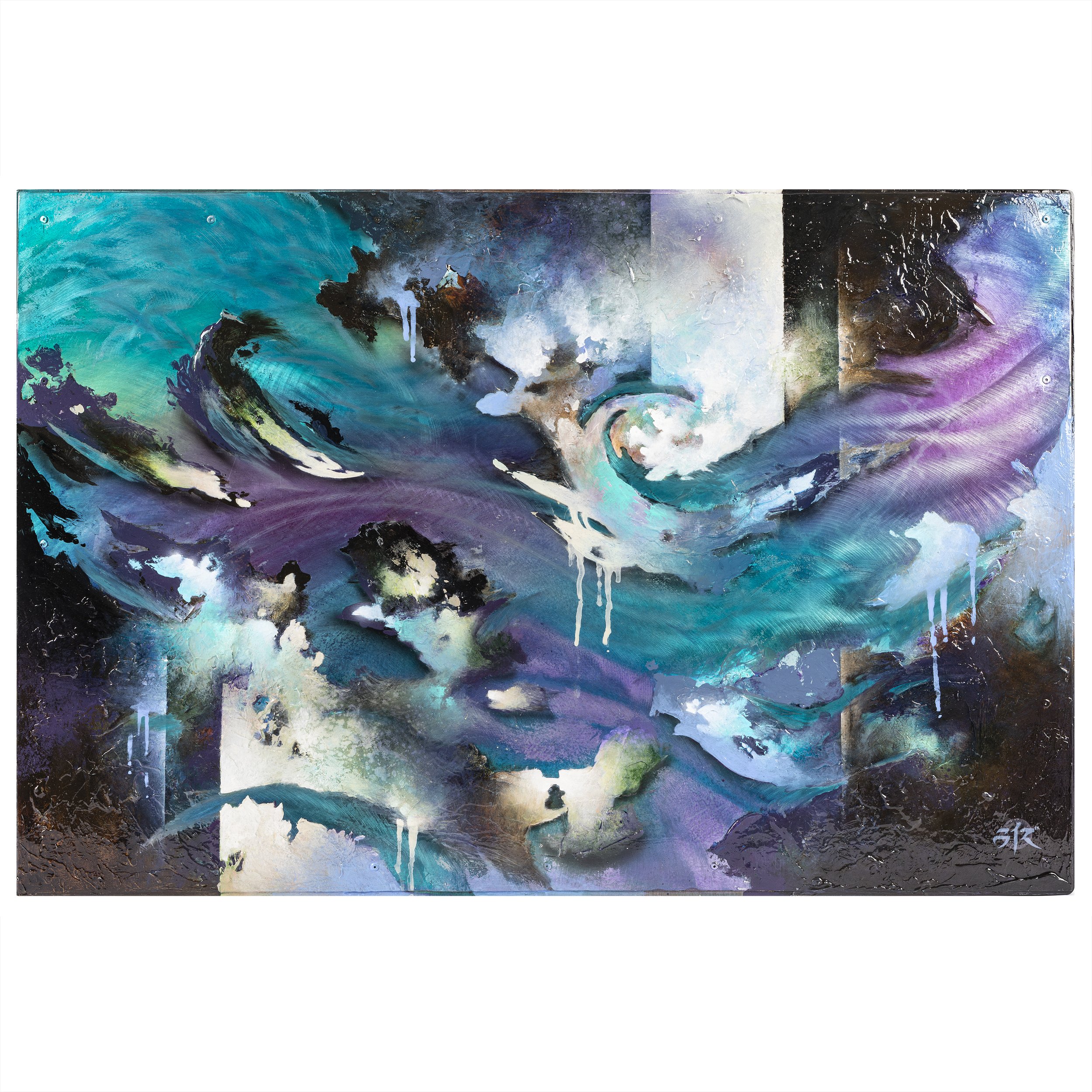
“Serenity Wash Over Me” is an abstract “Reverie™”-style metal painting with turquoise and violet flowing forms over reflective anodized surfaces that shift and glow with changing light.
For those of you who might be curious about what it is that galleries are looking for I’ll give you my two cents from years of experience. But I’ll need to break this down into a few segments so please read until the end. There’s a lot to unpack here. But ultimately, it’ll be up to you to decide whether or not what I have to say has any merit. If it does, I’d love to hear your story. Email me with “Gallery Advice” as the subject line and give me all the deets! I’m not a hard guy to find. Anyways, here goes…
A gallery is a business, first and foremost. Everything else is a distant second to them. But those distant seconds are your end of the bargain so don’t neglect them. The gallery’s job is to sell your artwork and shed some light on you as an artist to THEIR clients. Awesome! Their job is to tun you into a rockstar. Sounds easy enough. How hard can it be, right? If only things were that simple.
YOUR job, as an artist, is to give them something they can be proud to sell and that involves a great many things. First and foremost, quality. Not just of the art itself, but of the supports on which it was created. I’m sorry to tell you this, but the best premade canvases you can purchase at your local arts and craft store ARE NOT sufficient in the big leagues. If you know anything about support construction - aka canvas stretching / panel making - then you already know what I’m talking about. If you don’t know what I’m talking about just take my advice that they’re not good enough. It’s a long and lengthy discussion that I can’t really get into in one blog post. Luck for you, I have some videos on how I do build my cradled panels (link here: https://www.youtube.com/@billyrhyze). I don’t paint on stretched canvas because my signature painting technique “Reverie” requires a solid support. I’ll get into this more a bit further down the post.
Second is consistency. You MUST be able to produce excellent and equally excellent work in succession without fail. Each new piece must carry with it your signature aesthetic that is easily recognizable as a signal above the noise. Think of it as brand building. Take your favorite artist for example. Whenever you see one of their new pieces you know it’s from them without having to be told because you know their creative signature. Their signature aesthetic is their brand. THAT’S what galleries are ultimately looking for in a nutshell. It’s more complicated than that, but it’s a solid starting point for emerging artists who have questions about what it takes for galleries to even consider representing your work. If your body of work/brand is all over the place then you’re not ready. Pick a creative lane then dominate it. That’s how it’s done.
Third, moral character. Now this is a two-way street. I’ll explain. When you sign a contract with a gallery for representation, everything is stipulated in the contract, and YES it is a CONTRACT. What your obligations are, what theirs are…everything. If it’s not in writing, it’s not a thing and doesn’t exist. Because that’s how contracts work, end of argument. Most gallery owners are forthcoming and very honest up front. Most of the time, their contracts are reasonable according to industry standards. It is up to you to do your homework to fully understand what those standards are and it is up to you to decide whether or not you will be able to faithfully execute your obligations should you agree. If you can not meet your obligations, DO NOT SIGN. A gallery owner will respect you more for candid honesty up front than having to deal with unprofessionalism once the ink is dry. However, should you decide to sign, keep reading…
As far as contracts go, if for any reason you don’t agree with a term(s) in your contract you simply cross it out, substitute your own and see if the gallery owner is willing to accept the new terms. If they are, great! Have them draft a new contract with the mutually agreed upon terms. If your terms are unreasonable per the industry standard, they may decline the offer to represent you. Galleries are looking to work with artists who fit their mold and not the other way around. So remember to be flexible. Not all galleries are alike. That is important to keep in mind.
However, if THEIR terms are unreasonable per the industry standard DO NOT sign the agreement. Before approaching any gallery, talk with some of the artists who are currently / were once represented by them to get their candid feedback about their experience and what their obligations were. That will give you some idea about whose door you’re thinking about knocking on. If you don’t know what the industry standards are, go to an artist’s opening that you like, preferably at a gallery that you like, get their socials and hit them in the DMs 😉. You’ll be surprised that many artists will be happy to oblige and Google isn’t what it used to be for looking up these kinds of things…but I digress.
Now, as far as my videos on YouTube go, I start off with small cradled art panel builds because these are easiest for beginners to learn the basics. I have another video showing how to make medium sized cradled art panels that utilize all the steps learned in the first video with a couple extra for additional support on account of the larger size. My third video is a two part series that shows how I build even larger cradled panels using all the techniques from video 1 and 2, with again a few more extra steps to lend even more structural integrity to panels that are almost certain to warp without them. Yes, it requires power tools and knowledge how to safely use said tools. It is an invaluable skill to acquire if you don’t already know how. I can not stress this enough. It saves SO much money over time and, if you follow the techniques I demonstrate, aesthetics consistency will become second nature. You are free to improvise and improve on any of the build techniques I give to the world for free. If you know a better way to achieve top notch, professional-looking results I’d love to hear about it in the comments. I’m always looking for ways to improve too!
Final thoughts on what galleries are looking for in artists: Professionalism
Aside from creating outstanding and consistent works one key thing to remember always is that gallery representation is a symbiotic relationship. You must conduct yourself professionally outside their walls at all times because what you do reflects back on them in the aggregate if not directly. Professionalism at all times, dig? With that said, it is wise to drive all sales through your representative galleries. DO NOT sell works that are similar in nature to works that your representative gallery is currently showcasing to your own private clients - behind the gallery’s back. I’ve seen it happen, it doesn’t end well and is to a large degree incredibly dishonest. It’s not that you can’t sell other works on your own to private clients you may have but my advice is to get the gallery’s blessing first to make sure they don’t feel like they’re getting burned. Professional artists don’t set fire to bridges they worked so hard to build. If sales are booming outside the gallery’s purview then maybe you’re wasting their time. I’m sure that’s how they’re gonna feel about it. No funny faces, know what I mean?